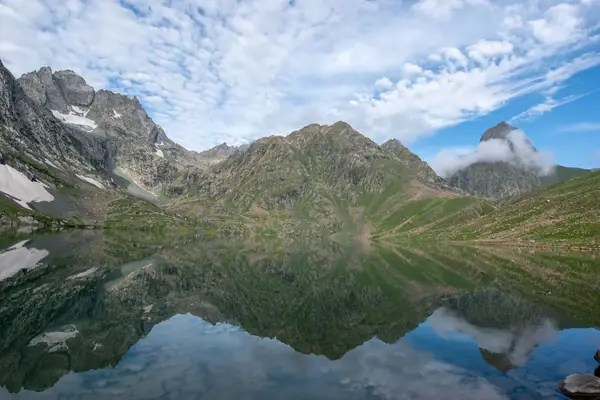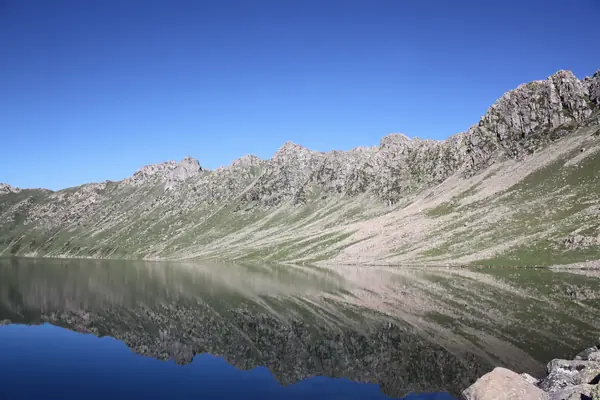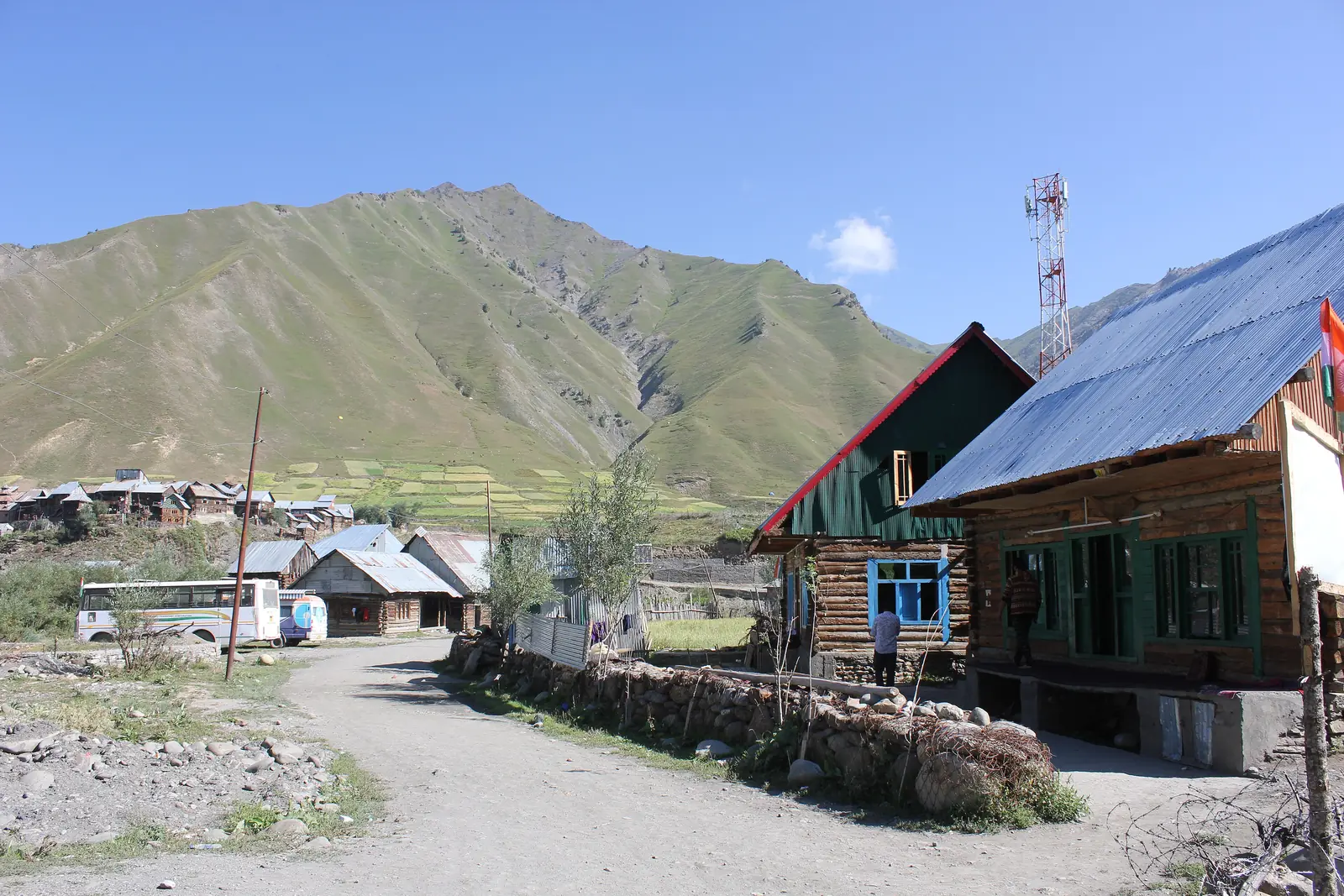
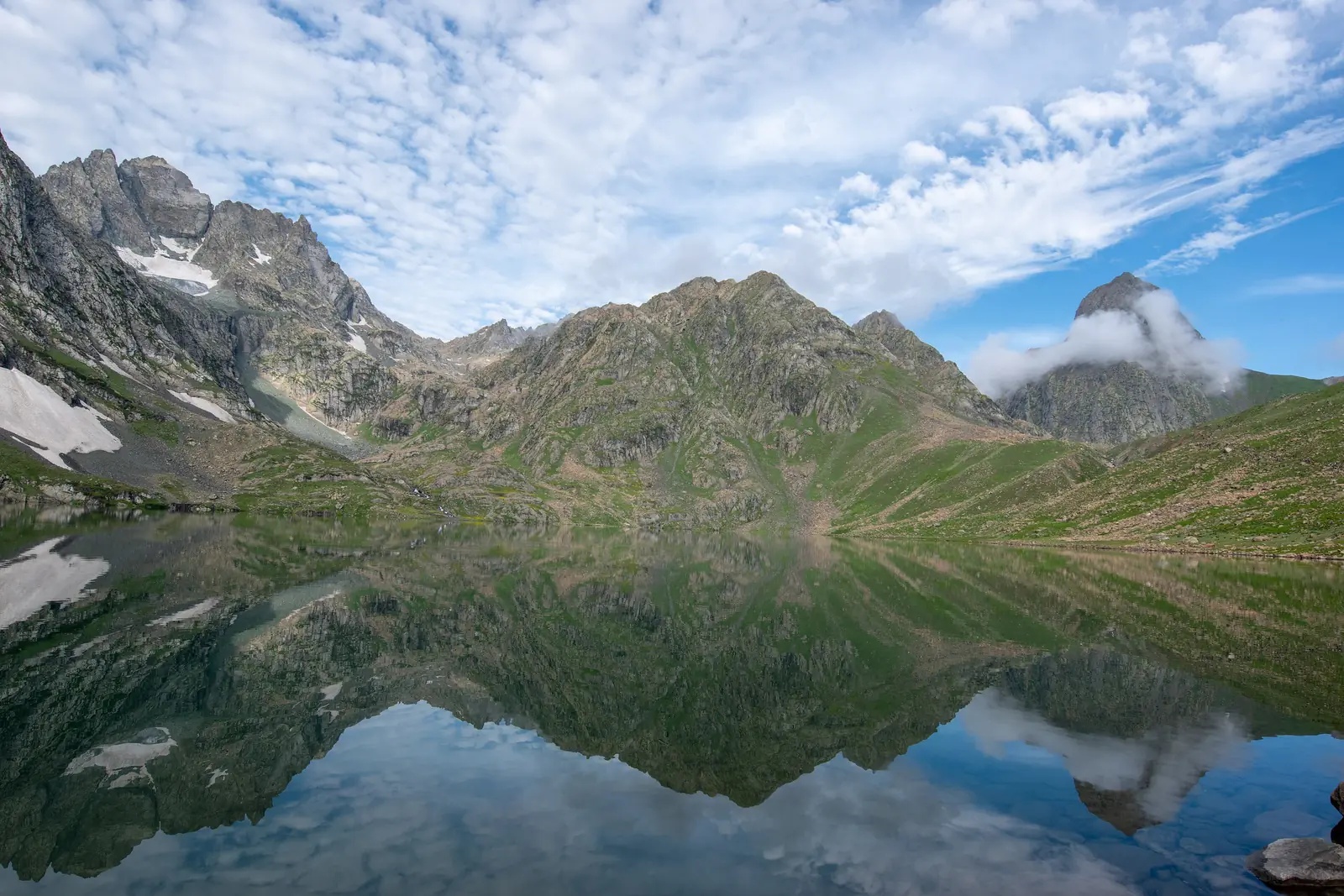
The Kashmir Great Lakes trek is the walk most people mean when they say they want to trek in Kashmir. Over about 70 km it links a chain of high alpine lakes between Sonamarg and Naranag: Vishansar, Kishansar, Gadsar, the Satsar lakes, Gangbal and Nundkol. You cross three passes of around 4,000 m or more, camp beside water most nights and see almost no roads for a week.
We run this trek every summer, so this guide is written from the trail rather than from a map. It covers the route day by day, how hard it really is, the best months, permits and ID, what to pack and how to choose the right departure.
Kashmir Great Lakes trek at a glance
| Detail | What to expect |
|---|---|
| Start and finish | Shitkadi near Sonamarg, finishing at Naranag |
| Distance | About 70 km of walking |
| Days on the trail | Seven, plus a spare day in our version |
| Highest point | Gadsar pass, about 4,200 m |
| Other passes | Nichnai (about 4,080 m) and Zaj |
| Season | Usually July to mid-September |
| Difficulty | Moderate to demanding |
The route, day by day
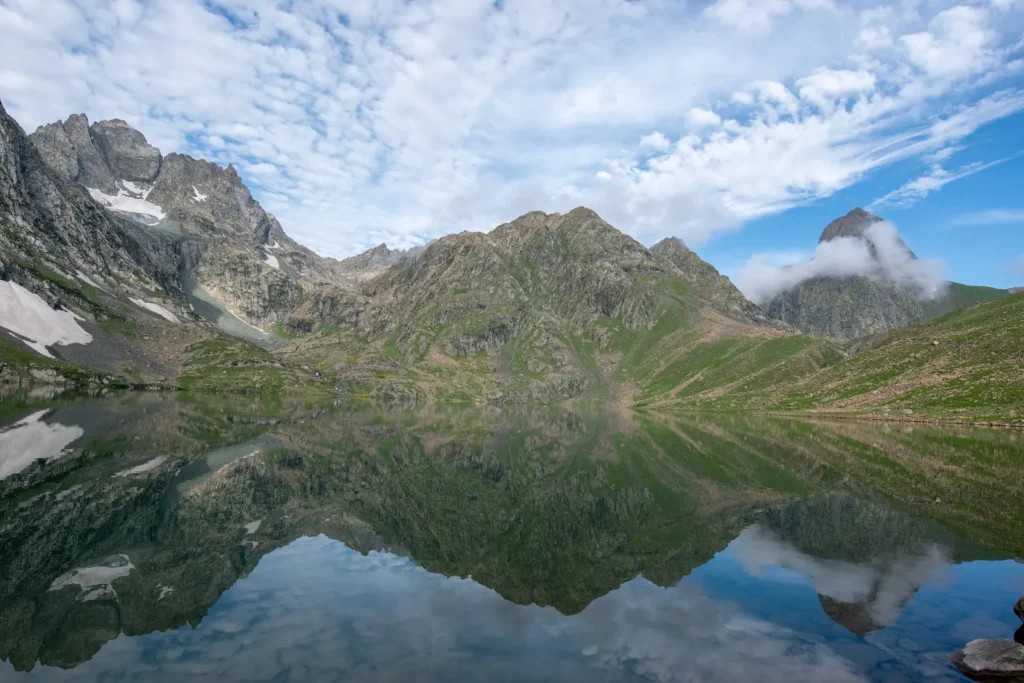
Most groups walk the trek from east to west, starting near Sonamarg and finishing at Naranag. That direction puts the steady climbs early, when your legs are fresh, and the big views of Mount Haramukh at the end. These are the stages we use on our Kashmir Great Lakes trek.
Day 1: Srinagar to Sonamarg
A three-hour drive up the Sindh valley to camp near Shitkadi, at about 2,730 m. Use the evening for a kit check and a short walk. Sleeping at this height before you climb higher helps your body adjust.
Day 2: Sonamarg to Nichnai
About 11 km. The trail climbs through birch and maple to the Table Top meadow, then follows the Nichnai stream to camp at about 3,500 m. It is a long first day, so walk at a pace where you can still talk.
Day 3: Nichnai pass to Vishansar
About 12 km. You climb to Nichnai pass at about 4,080 m, then cross open meadow to Vishansar lake at about 3,650 m. The first sight of Vishansar from the pass is one of the best moments of the trek.
Day 4: Over Gadsar pass
About 15 km and the hardest day. A steep climb past Kishansar takes you to Gadsar pass at about 4,200 m, the high point of the Kashmir Great Lakes trek. On a clear morning you can see both Vishansar and Kishansar below you. Then it is a long descent beside Gadsar lake to camp.
Day 5: Gadsar to Satsar
About 12 km through meadows, and gentler. There is an army post near Satsar where every trekker’s ID is checked, so keep your documents in your day pack.
Day 6: Zaj pass to Gangbal
About 11 km. You cross a boulder field and Zaj pass, then drop to Gangbal, with Nundkol just beside it under the face of Mount Haramukh. This is the camp most people remember longest.
Day 7: Spare day at Gangbal
We keep this day free on purpose. If weather held the group at an earlier camp, this is the day we use, so you still finish on time. If not, you walk round to Nundkol or simply rest by the water.
Day 8: Down to Naranag
A steep descent of about 1,300 m through pine forest to Naranag and its eighth-century stone temples. Knees take the strain here, so trekking poles help. From Naranag it is about two hours by road to Srinagar.
How difficult is the Kashmir Great Lakes trek?
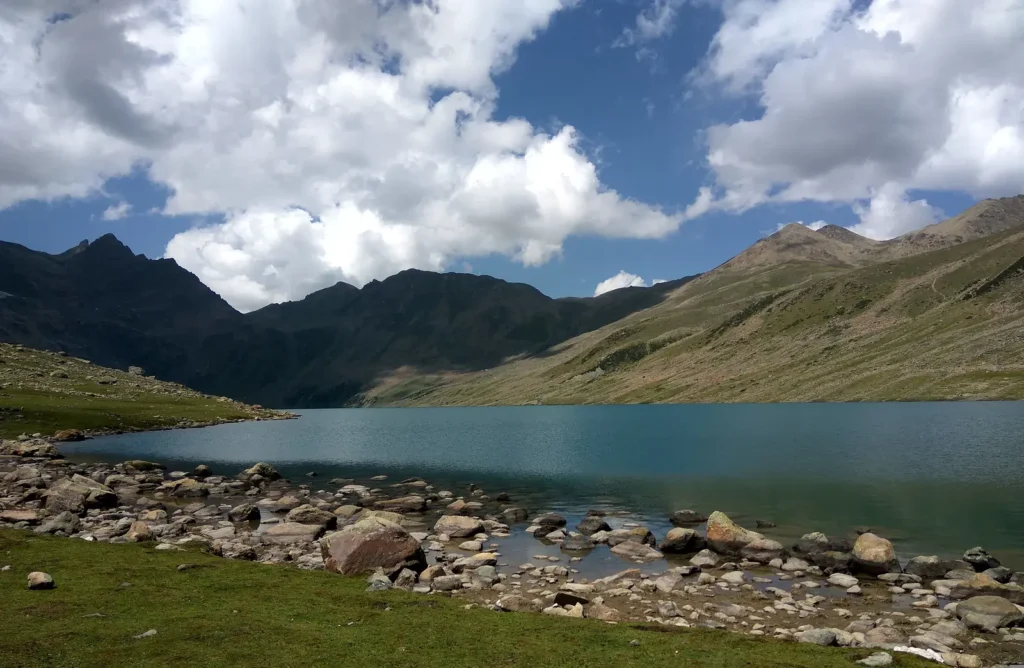
It is a moderate to demanding trek. No technical climbing is involved, but you walk six to eight hours a day for a week and cross three passes at around 4,000 m or higher. The hardest parts are the climb to Gadsar pass, the boulder field before Zaj pass and the final descent to Naranag.
A useful test: if you can run 5 km in under 40 minutes and walk up stairs for half an hour without stopping, you are in good shape for it. Start training at least six weeks before your departure:
- Brisk walks or hikes of two to three hours, with a loaded day pack.
- Stair climbing or hill walking twice a week, for the long ascents.
- Steady running or cycling three times a week, for stamina.
- Squats and lunges, to protect your knees on the descents.
Altitude and staying well
Most of the trek is above 3,500 m, where altitude sickness is a real risk even for fit people. The usual early signs are headache, nausea, poor sleep and unusual tiredness. The trek gains height gradually, which helps, but you also need to look after yourself:
- Walk slowly on the climbs and drink three to four litres of water a day.
- Tell your trek leader about any symptoms straight away. Mild symptoms often pass with rest; worsening ones mean going down.
- Talk to your doctor before the trip, especially if you have a heart, lung or blood pressure condition.
Whoever you trek with, ask what safety kit the leader carries. A full first aid kit, a pulse oximeter and bottled oxygen are the minimum to expect on a trek this high.
Best time for the Kashmir Great Lakes trek
The trekking season is usually July to mid-September. Before July, snow often still covers the passes and the lakes can be partly frozen. After mid-September, nights at the high camps drop well below freezing and the first snow can close the passes.
- July: the meadows are full of flowers and the streams run high. Expect some snow patches on the passes early in the month.
- August: the most settled month, with the most departures. Kashmir misses most of the Indian monsoon, though afternoon showers are common in the mountains.
- Early September: clear skies, fewer trekkers and the first autumn colour. Pack extra warm layers for the nights.
Permits, ID and rules on the trail
Indian trekkers need an original government photo ID and two photocopies for the army checkpoint near Satsar. Foreign nationals need their passport and visa.
Please carry all plastic back down. The lakes are fragile and the trail stays beautiful only because trekkers and teams leave nothing behind.
What to pack
- A 40 to 50 litre backpack (if you carry your own load) or a 20 to 30 litre day pack (if ponies carry it).
- Trekking shoes with good grip, already broken in, and two pairs of woollen socks.
- Thermal inner layers, a fleece, a down or padded jacket and a waterproof shell.
- Waterproof trousers, a sun cap, a woollen cap and gloves.
- Sunglasses, sunscreen and lip balm, because the sun is strong at this height.
- Two one-litre water bottles, a headlamp and trekking poles.
- Your personal medicines and your ID documents in a waterproof pouch.
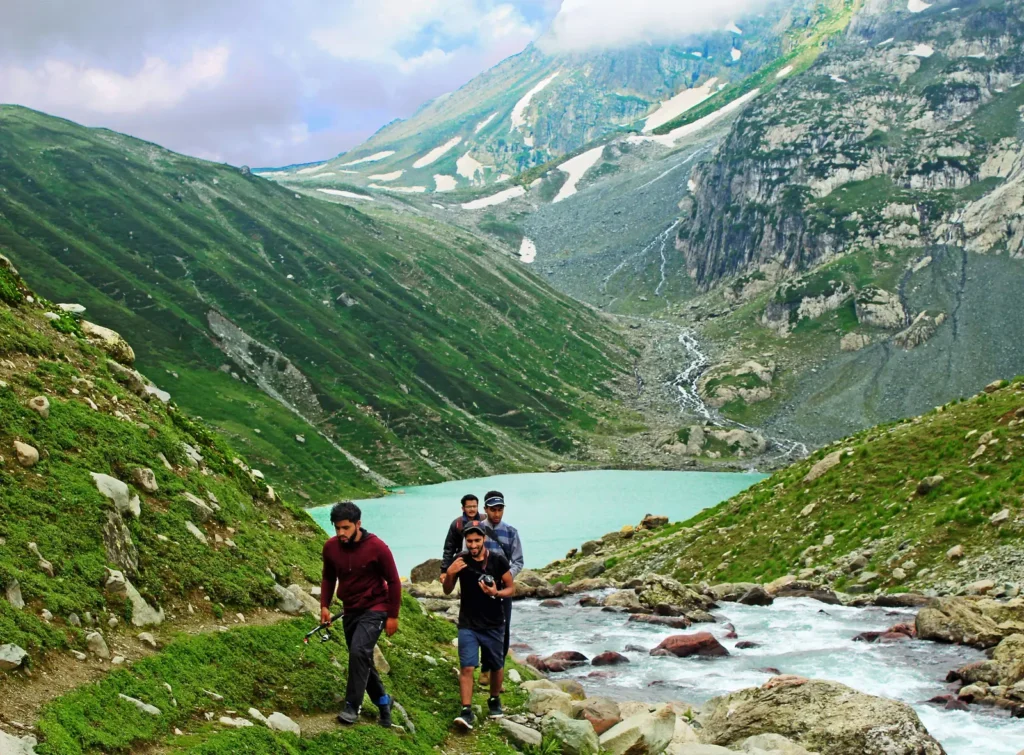
On our departures a cook, helpers and ponies carry the camp, the food and your main bag, so you walk with only a day pack.
Choosing the right departure
When you compare Kashmir Great Lakes trek operators, ask four questions:
- Is there a spare day in the plan, in case weather closes a pass?
- How many trekkers are there for each trek leader, and are the leaders trained in wilderness first aid?
- Are ponies included for the main loads?
- What happens at the end: is the drive back to Srinagar included?
Our version keeps the spare day at Gangbal, small groups, ponies for the loads and a houseboat night in Srinagar after the descent. See the full plan and price on our Kashmir Great Lakes trek page. If you want a shorter trek first, the Tarsar Marsar trek from Aru is a fine six-night alternative, and you can read more about the start and finish points on our Sonamarg and Naranag and Gangbal pages.
For background on the lakes themselves, the Gangabal Lake article on Wikipedia is a good place to start.